How to Read Your Kundli With AI: A Beginner's Guide
Learn how to read your kundli with AI step by step — lagna, planets, houses, nakshatras and dashas explained using HeyKundli.
How to Read Your Kundli With AI: A Beginner's Guide
Vedic astrology has guided decisions for thousands of years, but the language of a birth chart — Sanskrit terms, planetary dignities, dasha cycles — can feel impenetrable to anyone who didn't grow up with it. AI kundli reading changes that. Tools like HeyKundli translate a complex horoscope into plain, personalised explanations the moment you enter your birth details. This guide walks you through every major layer of a kundli so you know exactly what you're looking at and what the AI is telling you.
What Is a Kundli and Why Does It Matter?
A kundli (also spelledkundali) is a Vedic birth chart — a snapshot of the sky at the exact moment and place you were born. It maps the positions of the Sun, Moon, and seven classical planets across twelve houses and twelve zodiac signs. Unlike a Western horoscope, a kundli uses the sidereal zodiac, which aligns with the actual constellations rather than the seasons, typically placing planets 23–24° earlier than their Western equivalents.
The chart is the foundation for understanding personality, life themes, career potential, relationships, and timing of key events. Every element — sign, house, planet, nakshatra — adds a layer of meaning. Reading all those layers simultaneously is where most beginners get stuck, and where AI birth chart analysis genuinely earns its place.
Step 1 — Generate Your Chart on HeyKundli
Before the AI can explain anything, it needs three data points:
Date of birth — day, month, year
Time of birth — as precise as possible; even a 4-minute error can shift the rising sign
Place of birth — city or town, so the system can calculate the correct local sidereal time
[Screenshot placeholder: HeyKundli birth-details entry form]
Once submitted, HeyKundli renders your chart in the classic North Indian square format (or South Indian diamond format, depending on your preference) and populates every house with the relevant planetary glyphs. The AI engine then begins parsing the chart in the background, ready to answer questions or deliver an automatic reading.
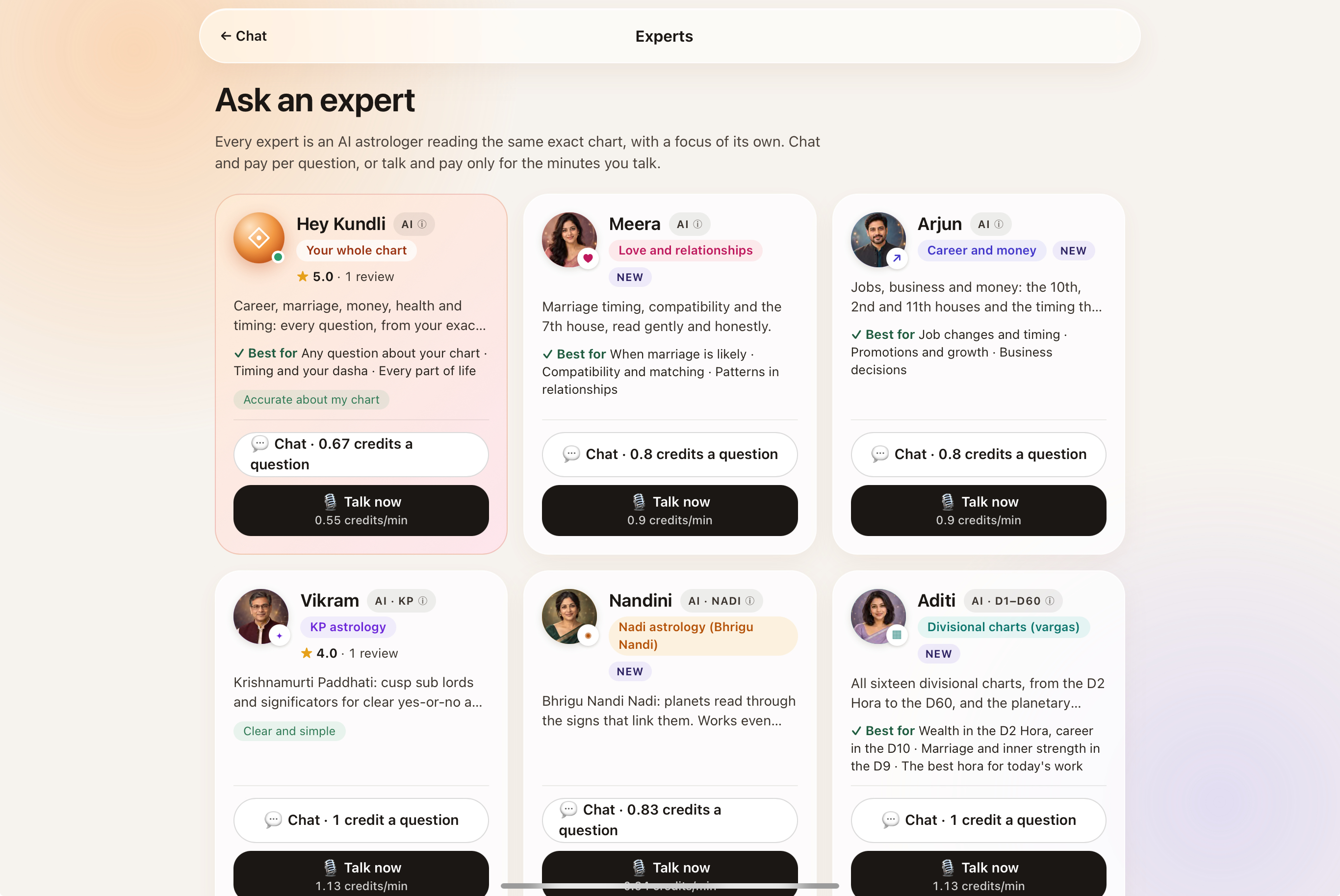
If you want a broader look at how the platform fits into the wider AI astrology landscape, the HeyKundli platform overview covers its full feature set.
Step 2 — Identify Your Lagna (Ascendant)
The lagna, or ascendant, is the zodiac sign rising on the eastern horizon at birth. It is the most personal point in the chart because it depends on the exact birth time and location. In the North Indian chart, the lagna is always shown in the top-centre box.
Why it matters:
It sets the house numbering — House 1 is the lagna sign, House 2 is the next sign clockwise, and so on.
It colours your entire personality and physical appearance more than your Sun sign does.
Every planet's house placement is counted from the lagna.
[Screenshot placeholder: HeyKundli chart with lagna highlighted in House 1]
The AI will typically open its reading with a paragraph describing the lagna sign's core traits — for example, a Scorpio lagna might be described as intense, perceptive, and drawn to transformation.
Step 3 — Read the Planets and Their House Placements
Vedic astrology works with nine grahas (planets): Sun, Moon, Mars, Mercury, Jupiter, Venus, Saturn, and the lunar nodes Rahu and Ketu. Each planet carries a natural signification:
Planet | Core Significations |
|---|---|
Sun | Soul, authority, father, vitality |
Moon | Mind, emotions, mother, habits |
Mars | Energy, courage, siblings, property |
Mercury | Intellect, communication, trade |
Jupiter | Wisdom, wealth, children, dharma |
Venus | Love, creativity, luxury, relationships |
Saturn | Discipline, karma, longevity, delays |
Rahu | Ambition, obsession, foreign elements |
Ketu | Spirituality, detachment, past lives |
The house a planet occupies modifies its expression. Jupiter in the 5th house (children, creativity, speculation) amplifies those themes positively. Saturn in the 7th house (partnerships) may indicate delayed or karmic relationships.
[Screenshot placeholder: HeyKundli planet-by-planet breakdown panel]
The AI reads these combinations automatically. Ask it a direct question — "What does my Jupiter placement mean for my career?" — and it cross-references the planet, its house, its sign dignity, and any aspects it receives before answering.
Step 4 — Understand the Twelve Houses
Each house governs a specific life domain. Here is a quick reference:
1st — Self, body, personality
2nd — Wealth, family, speech
3rd — Courage, siblings, short travel
4th — Home, mother, property, happiness
5th — Children, intelligence, past-life merit
6th — Health, enemies, debts, service
7th — Marriage, partnerships, business
8th — Transformation, longevity, hidden matters
9th — Dharma, higher learning, father, luck
10th — Career, public reputation, authority
11th — Gains, social networks, aspirations
12th — Losses, spirituality, foreign lands, liberation
A house becomes especially active when it contains planets, when its lord (ruling planet) is strong, or when it is activated by a dasha period (see Step 6).
Step 5 — Explore Your Nakshatras
Nakshatras are the 27 lunar mansions of Vedic astrology, each spanning 13°20' of the zodiac. Your Moon nakshatra (also called janma nakshatra or birth star) is considered the most personally significant, used in muhurta (auspicious timing), compatibility matching, and dasha calculation.
[Screenshot placeholder: HeyKundli nakshatra detail card for Moon]
Each nakshatra has:
A deity (devata) that colours its energy
A symbol that encodes its core theme
A ruling planet that links it to the dasha system
A pada (quarter), placing it in a specific navamsha sign
For example, a Moon in Rohini (ruled by the Moon, symbolised by a chariot) suggests someone sensual, creative, and materially inclined. HeyKundli's AI surfaces these layers automatically, saving you from cross-referencing multiple texts.
Step 6 — Decode Your Dasha Timeline
The Vimshottari dasha system divides life into planetary periods totalling 120 years. Each planet rules a major period (mahadasha) of fixed length:
Sun — 6 years
Moon — 10 years
Mars — 7 years
Rahu — 18 years
Jupiter — 16 years
Saturn — 19 years
Mercury — 17 years
Ketu — 7 years
Venus — 20 years
Your starting dasha is determined by your Moon's nakshatra at birth. Within each mahadasha run nine sub-periods (antardashas), and within those, finer pratyantardashas. The dasha system is the primary timing tool in Vedic astrology — it explains why certain themes dominate specific years of your life.
[Screenshot placeholder: HeyKundli dasha timeline with current period highlighted]
HeyKundli's AI overlays your natal chart strengths and weaknesses onto the active dasha. If you are in a Saturn mahadasha and Saturn rules your 10th house from a strong position, the AI might flag this as a period of sustained career effort and eventual recognition — with realistic caveats about Saturn's tendency toward slow, earned results.
How Accurate Is AI Kundli Reading?
AI birth chart analysis is remarkably good at pattern recognition — identifying yogas (planetary combinations), calculating dignity scores, and explaining classical principles consistently. Where it has limits is in the nuanced, context-sensitive judgement an experienced human astrologer develops over decades.
For a balanced view of what the technology can and cannot do, the article on AI astrology accuracy examines the evidence in detail. The short answer: AI is an excellent learning tool and a reliable first layer of interpretation; it works best when you treat its outputs as informed starting points rather than final verdicts.
FAQ
What information do I need to read my kundli with AI?
You need your date of birth, exact time of birth, and place of birth. The birth time is critical — a difference of just a few minutes can change your lagna and shift planetary house positions.
Can AI read my kundli in English?
Yes. Platforms like HeyKundli generate full readings in plain English (and several other languages), translating Sanskrit terminology into accessible explanations without losing technical accuracy.
Is AI kundli reading as good as a human astrologer?
AI excels at consistent, instant, and affordable chart interpretation. A seasoned human astrologer brings intuition, life experience, and the ability to ask follow-up questions. For most beginners, AI is an excellent and practical starting point.
What is the difference between a kundli and a horoscope?
The terms are often used interchangeably, but "kundli" specifically refers to the Vedic (sidereal) birth chart used in Indian astrology, while "horoscope" more commonly refers to Western (tropical) astrology charts. The underlying birth data is the same; the calculation method and interpretive framework differ.
How do I know which dasha I am currently in?
HeyKundli calculates your current mahadasha and antardasha automatically from your Moon nakshatra and birth date, and displays the active period with start and end dates on your dashboard.
Conclusion
Reading a kundli used to require years of study or access to a knowledgeable astrologer. AI kundli reading democratises that knowledge — giving anyone with a birth time and place an instant, layered analysis of their lagna, planetary placements, houses, nakshatras, and dasha timeline. HeyKundli makes that process visual and conversational, so you can ask follow-up questions and drill into the details that matter most to you.
Start with your lagna, understand where your planets fall, note which houses are active, identify your Moon nakshatra, and check which dasha you are living through right now. Those five steps give you a working map of your chart — and the AI is there to explain every turn.
Ready to explore your chart? Generate your free AI kundli reading on HeyKundli and start understanding your Vedic birth chart today.
Keep reading
HeyKundli articles are for understanding and reflection, not medical, legal or financial advice.